Friday, July 15, 2011

Health in Focus

Health is a major issue, and several of the Millennium Development Goals focus directly on health. 
Grameen Caledonian College of Nursing: An Introduction


Empowering Bangladeshi Women - One Nurse at a Time
Photo with permission, taken by author 

There is a shortage of doctors and nurses in Bangladesh. As of right now, there is 3 doctors for every nurse, but there should be 1 doctor for every 3 nurses.

"Nursing the Future Together"
The Grameen Caledonian Nursing College was established in March 2010, and is the first Grameen nursing institution. It's a collaboration between Grameen Trust and Glasgow Caledonian University UK.
It is a social business to change lives, that educates unmarried daughters of Grameen Bank borrowers to become well equipped nurses and midwifes of international quality. The school follows government nurse curriculum, and the program also includes English and Computer classes. The students get interest free Higher Education Loans. The rural girls also have guaranteed employment after completing the nursing degree.

As part of the internship we got a tour of the school and met some of the girls studying there. The nurse students shared their excitement about their studies and their hopes for what benefits their education can provide to others. 

Nurses and Their Importance 
Health is certainly an essential and very important issue, and I was moved by the enthusiasm by the nursing students.  Ending the shortcome of nurses is essential for the health and well being of people. Therefore nursing and midwifery education really is the way to promote and improve the health and well being of the Bangladeshi people.

Grameen Kalyan: Welfare and Health Care

"Support and implement sustainable programs aimed at bringing better livelihood to people especially in rural areas and to minimize inequality and disparity." Vision of Grameen Kalyan 

Grameen Kalyan has since it was established in 1996 provided welfare and health care programs. Primary health care centers are one of the services that Grameen Kalyan offers in rural areas. The health care centers provides primary services out in the field. Preventative measures are the focus of these health facilities. People learn about sanitation and the use of soap and washing of hands before eating to avoid water borne diseases such as diarea. Preventative measures are also taken in terms of maternal health by identifying risk pregnancy through portable devices. 

Micro Health Policy
Insurance can be bought by both Grameen borrowers, and non-borrowers. The cost for Grameen Bank borrowers is 200tk, for 6 family members for one year, and the cost for non-borrowers is 300tk. This provides regular health check ups, and cheaper prescriptions. Because of regular medical check ups, problems are screened, and serious illnesses may be avoided. Arrangement for doctors in case needed and surgery is also provided. The insurance covers up to 2000 taka for a surgery costs. In addition, having the insurance might in some cases mean that the surgery will be cheaper. 

Grameen Kalyan provide services that works towards at least two specific goals of the Millennium Development Goals, namely Child Health and Maternal Health.  

North and South Korean experiences

... In Bangladesh
Who would have thought that North Korean food is so different from South Korean food? Well, it is, and I had the unique opportunity to try both, in the same week!

South Korean Restaurant 
First South Korean Food Experience
The South Korean Restaurant, Sura Restaurant, was beautifully decorated, and the servers were mostly men in white shirts with patterns of bowties. My two friends from Korean ordered the food, so I was very excited to try it. The servers brought out a frying pan, and placed it in the middle of our table for us to fry it ourselves. The food was spicy, and the rice sticky, just as it should be. We had South Korean vodka, which is very strong! And we finished the meal with some type of dessert tea, naaam... The smell reminded me of Norwegian rice porridge.

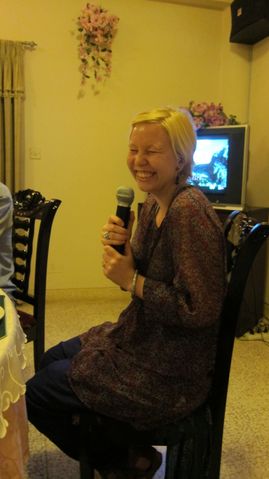
Me attempting at Karaoke
 taken by Shaxuan Lizzie Shan 

A First Glimpse of North Korea 
Pyongyang Restaurant, the North Korean Restaurant was full of surprises. When we first arrived we sat in a room with a TV playing music videos of what I'm assuming to be traditional North Korean songs. Because a party was coming, we were moved to one of the private dining rooms at the restaurant. The private room had a round table, with a glass table on top that could be turned around to easily access all the food on the table. There was a wash room, with everything including a bathtub. Inside the room that was nicely decorated with North Korean art, there was also a Karaoke machine. All the food was very good, but not as spicy as the South Korean food. I tried what North Korean food is most well known for; their cold noodles. The flavor was very good, but it was weird to eat good noodles, mind you with chopsticks.

North Korean Waitress Singing Karaoke 
After the food, we wanted to sing Karaoke, and the waitress, dressed in a simple blue dress with a white collar sang for us! Her singing voice was beautiful! We tried to take pictures, but it is not allowed as the restaurant is operated by the North Korean Government and the waitresses are all actually from North Korea! As we were not permitted to take photos, I'm not posting any of my pictures of this.
We finished the night by singing Karaoke Asian style! (well, I attempted at least)
Throughout the Karaoke songs, beautiful images of North Korea came across the screen.

After this unique opportunity and first encounter of eating both South and North Korean food, in Bangladesh, one thing is certain; I want to travel to both countries in the near future.

Tuesday, July 12, 2011

Free as a Bird after strikes in Bangladesh

Photo by author. Not connected with strike
Finally! The strikes are over, for this time around at least.  After schools and offices have been closed for several days, we could go back to work today.

Results of the strikes?
Walking in the streets today, I saw a burned out bus. The smashed bus looked very randomly placed by a sidewalk off of one of the main streets.

Overview of the Strikes 
I will give you an insight into the strikes on July 6-7, and then again July 10 and 11. (I'm by no means an expert.) We were recommended not to leave the hotel as violence sometimes occur during the strikes. The Bangladesh Nationalist Party called the first strike. According to CNN, they called the strike due to the government's failure to regulate the capital market of Bangladesh and failure to curb commodity prices, such as increase of food prices and gas prices. BBC reported that 10 vehicles were torched overnight July 6th. A number of people were injured and arrested.

The police used tear gas in the 30 hour strike on July 10 and 11. This second strike was organized to protest the removal of a religious pledge from the Bangladesh constitution.

Personal Experience of Strike 
I did not see or hear any of the strikes, and it was very peaceful in the streets where I live. I heard that most of the disruption happens right outside of Dhaka instead of inside the city. The police has a lot more control inside the city, than outside of it as I understood. From friends, I heard that many people used the day shopping and dining at restaurants, just like any other weekend day off from work. As we foreigners were under the impression that we should not leave the hotel, we had a few very boring days.

One thing is for sure, I did not enjoy being inside for so long, not being able to go outside. Until now, I think perhaps I had underestimated the importance of being able to move around freely.
Today, I felt free as a bird. It was a lovely feeling to no longer be trapped in a hotel.

Friday, July 8, 2011

Student Initiated River Clean Up Banani, Dhaka

"Think Green - Live Green" 
Students cleaning up the river from a boat 

High School students from around Dhaka gathered to clean up the Banani river early in Friday morning. 
Cleaning both land and in the water, the students contributed to a cleaner river. 

Student Initiated 
Cleaning up the river is organized and initiated by the students. It's very inspiring to see high school students cleaning up a river next to Dhaka city's slum area. A cleaner environment is beneficial to everyone, especially for the people living in the slums along the riverside. A better environment is a cleaner environment. Think Green - Live Green. 

Images of students in lime green and orange.  
Students participating in the clean up 

There were students in easily identifiable outfits, with their lime green caps and white t-shirts saying "Think Green - Live Green", on all four sides of the bridge and along the river. As the t-shirts had several logos, I'm assuming the students had more than one sponsor for their clean-up efforts. Boats were used to easier clean up the riversides, with an added color of orange for the life-wests. 

Take Initiative 

We should learn something from the Dhaka High School students. Perhaps they couldn't clean the whole river. Perhaps they thought their efforts was useless, as when they cleaned some trash, more was found. But I'm certain by seeing their efforts myself, that their work is appreciated and worthwhile. This student initiated organizing shows that everyone can do something to improve the world we live in. 

The key just might be to realize that it's the small changes that will make the big changes when seeing the whole picture. Everyone can make a difference - one step at a time..


I met some children when taking photos and seeing the clean up, and they seemed to be excited at least. Perhaps to have a cleaner river to swim in? 

Children by the riverside 
Children playing in the Banani River


Thursday, July 7, 2011

Ami Khushi

Photo taken with permission by Shaxuan Lizzie Shan
Spending time out in the field, spending days and nights in a branch office in rural Bangladesh was really neat. I really enjoyed it. The village was so peaceful and friendly.
Photo taken with permission by Shaxuan Lizzie Shan
Village Visitors 
Some of the women of the village would come knocking on our door in the afternoons.  They wanted to see us, the three foreign interns from abroad. Standing in the doorway with curious eyes, our conversations usually started by introducing ourselves with names. This was the easy part of the conversation, us speaking in English and the woman and children in their native language, Bangla. Marriage and number of children was commonly the topic of these conversations. They always asked if we were married, or had children. The two other interns would comment that I'm engaged. The women would indicate being married by their nose-rings, or the lack thereof meant that they were either not married or their husbands gone, either left or dead. It seemed to be of great entertainment to the women to compare their skin colors to our pale skins. As we pulled up the cloth covering our arms, they would giggle lightly while placing their arms next to ours. It reminded me of the summer time in Norway, when we would indirectly compete of being the most tan by comparing by placing our arms next to a friends arm.
Photo taken with permission
by Shaxuan Lizzie Shan
Marriage 
At the centre meetings as well some of the women would ask if we were married. Again, the two other girls would tell them I'm engaged. So at the last centre meeting we went to, we had a great conversation with the women about marriage. We shared wedding traditions of Bangladesh, of China and Germany. Then they wanted me to tell them the story of my engagement. So I did. One short sentence at a time, so the translator could have time to repeat what I said in Bangla. They looked at me, I was blushing and smiling the whole story through. At the end of my story, after showing my ring, they asked what role our parents had played in it, if they had agreed. It was so interesting to learn of how the cultures varied in marriage traditions. In Bangladesh, it used to be that the parents would match up the children, and the daughter had to move to her husbands home. Before, the girls were often young, around 14.  Dowry was also paid. The Engagement consisted of the parents putting the rings (if rings were used) on the couples finger, not the husband to be himself, on the wife to be as is most commonly done in the West.  In these days, it seemed that the women were accepting of their own children choosing for themselves who to marry. Dowry is not supposed to be paid, and the girl have to be above 18 year of age.

Photo taken with permission by Shaxuan Lizzie Shan
Genuine Happiness Ami Khushi
Everywhere we went, people would start following us, walking behind us, staring at us. They were all friendly, curious to who we were and what we were doing. The children was often excited to see us, and would sometimes point. They really enjoyed to have their pictures taken, and seeing them afterwards. This brought such enjoyment! It was fun to see how excited they got to see their own image, how curious they were. The children brought such life to the village life.

The Village visit was very peaceful and nice. People seemed genuinly happy, despite hardships that they are working themselves out of through microcredit.  Especially compared to the city, where the first thing we encountered when coming back was beggars touching us and digging their hopeful eyes into us. When seeing children begging at night, my heart breaks. Should I give money, or should I not? Will it benefit, or will it just make it worse? I'm thinking of things I can do..

Ami Khushi means I am Happy. 


Pass the Peace.

Wednesday, July 6, 2011

Overnight Field Trip

Centre Meeting, take by author with permission
I spent four days in a division of Bangladesh that was closer to the countries of Nepal and Bhutan than the City of Dhaka. Rajshahi, Bangladesh was the destination early Saturday morning. The drive was as always crazy, with cars playing chicken with one another, and busses passing other vehicles in fast speed and cutting it close. After about 6 hours on the road, myself, a young woman from China and Germany along with the translator arrived at the Grameen Bank Branch Office we were to spend five days at. It later turned out that we needed to leave early, because of strikes, two years before the next election, in Dhaka, Wednesday and Thursday. Strikes here, means that violence can occur and cars burnt.
Dispursement at Branch Office
Taken with permission by author
We visited two centre meetings, had 5 exclusive interviews with five different women, an interview with a scholarship recipient for her singing, a female higher education loanee who studies philosophy and a struggling member. In addition we got to see the dispursment of money, meeting at the Area Office and visit from the Zonal Manager.
Capital Empowers Women 
My overall impression is that women are empowered through having capital. Some of the women in a centre meeting said that money brought them honor, and that their husband must come to them for money. In addition, they all indicated that they eat meals together with the family. It used to be more common that the women would eat when everyone else in the family had had enough, if there was anything left for her. Most of the younger female members usually only had two children, and it was more often that the older members had more. This indicates that the 16 decision, of having less children has impacted the women.
The Picture to the b is of the loan recording book, I got to fill one in, just like the Centre Manager does. 


Education 
All the women said they want their children to complete higher education. "As a mother I dream. Is there any mother who does not want their children to go to school", said one of the women we interviewed exclusively, in a colorful Sari with pinks, yellow, orange and some red. To the question "what do you want your children to study", the women always replied the same: what they want to study. I'm thinking it can have something to do with that the value of education itself is so important that what someone studies might not be as important as the higher education. Perhaps this reply can be connected with that the mothers don't know what their children can study, but then again, I think they know more than we think they do. In one instance a woman who's husband left her, her son stopped attending school after 5th grade. She said he was spoiled, and had bad friends. This made me wonder what position the husbands plays in sending the children to school.
The Indications of the Number of Saris 
Some of the women had no Saris, or maybe just one before becoming a Grameen Bank Borrower. Now, they have many. A woman stood up in the very back of a centre meeting of about 58 members, and said she used to have no saris, she had to borrow clothing before. Another woman we interviewed had 3 or four Saris before, now she has 5 for fine use, for visiting family, and 3-4 for normal use. After being a member for 8 years, one woman we interviewed have 6 or 7. Before she had only 3 saris. A new member, in a colorful sari, that reminds me of a rainbow, said she only have one Sari, the one she was wearing. I wonder how many Saris she will have after she starts her timber business with her first GB loan. As the number shows, when becoming a Grameen Bank borrower, the women can afford more clothing. The number of saris, or clothing, is a clear way of showing that the women are better off now.

I learned a lot, by talking with the women personally, and seeing in the improvements in their lives with my own eyes. I enjoyed being out in the field, in the peaceful villages.

Pass the Peace.